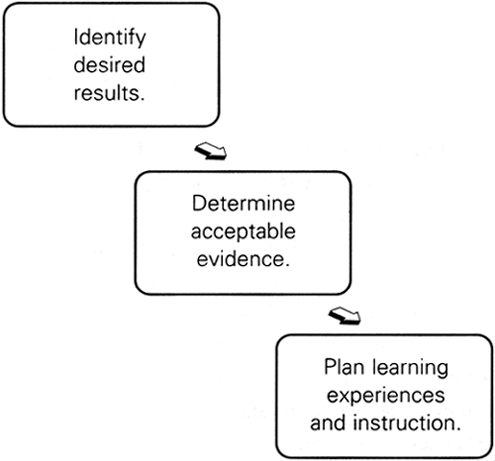
Backwards Design and Mastery Learning are two very important ways of teaching that can go hand in hand in order to help advance students’ to the best of their ability. First off, backwards design is a process that teachers use when planning units for their class. The backwards design, as you can probably guess, begins with developing the overarching objectives and desired goals for the students. As Jenny Pieratt writes on her blog post entitled “How to Create a Project Based Learning Lesson”, “Plan with the end in mind… once I have identified the standards and an authentic issue, I then jump to the final product”. Jenny is basically saying that after she identifies her big ideas of her unit, she then thinks about what she wants her final product to look like. By identifying what she wants her final product (i.e. what she wants her students to be able to do, and what she wants them to know) to look like, Jenny is able to better prepare her unit based around her desired results. This sort of thinking pairs directly with the other type of design called mastery learning. Mastery learning is focused around mastering a certain subject before being able to move onto the next subject. As Sal Khan explains in his TED Talk, “Let’s Teach For Mastery”, “It’s the way you learn a musical instrument, you practice the basic piece over and over again, and only when you’ve mastered it, you go on to the more advanced one”. This sort of design is used to help show students that truly mastering and understanding a concept, is better than just moving along in school based on how old you get. This design, therefore, pairs directly with backwards design because it also looks towards the end results first. When Sal is later talking about building a house and how you must master each step before moving onto the next, he begins with saying that his desired result is a house. Backwards design also relates to mastery learning because backwards design creates the whole lesson around achieving the goal, therefore if the lesson and unit are taught correctly, the end goal of mastery should be achieved.

The unit that I am designing will attempt to teach and assess in a way that supports student mastery of your learning goals because of the way that I am designing it, and how I am going to carry out my unit. I am using the backwards design to plan out my unit, which will therefore help me establish my learning goals and objectives first before everything else. I will also be thinking about what my desired product is, which is essentially having students master my content. This shows how by planning backwards I am ensuring that my final goal is student mastery. Then, as I continue to plan backwards I can keep my final goal in mind and plan meaningful and helpful activities and assessments for the unit. Another way to help promote student mastery as my final goal is to create assessments that will help me to see if my students are grasping the information and if they are on their way to mastering it. I will probably be administering and conducting multiple formative assessments in order to gain more information on my students’ learning. All in all, by deciding what my intention and goal for my lesson was before I began planning it, I was using the backwards design model. Then, by creating learning objectives and overarching goals that will be incorporated and reoccurring throughout the unit, I am ensuring student mastery of the unit. Do you think that there are more specific and helpful tools or models that I could use to further develop my unit? If so please let me know in the comments, all feedback is helpful!
Sources:
Jenny Pieratt “How to Create a Project Based Learning Lesson” : https://www.cultofpedagogy.com/project-based-learning-lesson/
Sal Khan TED Talk “Let’s Teach for Mastery” : https://www.youtube.com/watch?v=-MTRxRO5SRA
 Olivia's Blog
Olivia, thank you for sharing! This is a great blog post. I like how you connected mastery learning and backwards design. It also very clear how you plan to use both in your lesson. You also mention using formative assessments to help you craft lessons based on your students needs. Will you also be using a summative assessment as well?
LikeLiked by 1 person
Hi Olivia! I truly always look forward to your blogs. They have a clear structure and you make some very interesting points, such as the notion that your goal is student mastery! Once you have conducted the formative assessments, will you use that information on your student’s different levels to modify your lesson according to levels? Always love reading your blogs!
LikeLike
Hi Olivia! I truly always look forward to your blogs. They have a clear structure and you make some very interesting points, such as the notion that your goal is student mastery! Once you have conducted the formative assessments, will you use that information on your student’s different levels to modify your lesson according to levels? Always love reading your blogs!
LikeLike
Hi Olivia, thank you for sharing your excellent blog post! I really liked how you outlined your process of backward design for your unit plan. This ensures that your assessments and activities will be meaningful and connect back to your goal! I would love for you to tell your readers your unit topic and your progress with backward design. You talk about assessments that you will evaluate to assess your students’ mastery, what do you plan on assessing for your unit?
LikeLike
Olivia, when you state, “Another way to help promote student mastery as my final goal is to create assessments that will help me to see if my students are grasping the information and if they are on their way to mastering it. I will probably be administering and conducting multiple formative assessments in order to gain more information on my students’ learning,” this tells me that you are really thinking “backwards and are relating the assessments you design as an important part of the teaching and learning process.
LikeLike